
THANK YOU FOR SUBSCRIBING

Technology to Facilitate Business
× 
Applied Technology Review Weekly Brief
Be first to read the latest tech news, Industry Leader's Insights, and CIO interviews of medium and large enterprises exclusively from Applied Technology Review
Applied Technology Review: Specials Magazine

In industrial automation, precision measurement has traditionally relied on analog sensors connected to external signal conditioning electronics. While this architecture has served manufacturing reliably for decades, it is increasingly strained by modern production environments. Electrical noise, long cable runs, and growing system complexity place higher demands on robustness, repeatability, and ease of integration. Peter Hirt is responding by rethinking how measurement signals are generated, conditioned, and integrated directly at the machine level. The company develops high-precision measurement probes for automated machines and gauging systems based on LVDT technology, a principle historically built around fully analog signal chains. Instead of transmitting sensitive analog signals over long distances, Peter Hirt integrates the signal conditioning electronics directly into the probe. The analog measurement is converted into a digital signal immediately at the point of measurement, reducing susceptibility to interference while allowing calibration to be managed within a closed sensor system. According to Daniel Hirt, Chief Executive Officer, the objective is a digital sensor that provides reliable and precise measurement data. “With a digital probe, you have a closed sensor system,” he explains. “You get a numerical signal that fulfils modern calibration and measurement standards.” By closing the calibration chain within the probe itself, Peter Hirt aligns precision measurement with the expectations of contemporary automated production. IO-Link as an Open Integration Layer Digitising the measurement signal addresses noise and calibration challenges, but system integration remains critical. Modern production lines rely on heterogeneous automation architectures, and proprietary sensor interfaces often introduce long-term compatibility risks. To avoid these limitations, Peter Hirt adopted IO-Link as the communication interface for its probes.

Heavy-Lift Vtol Uav Solutions
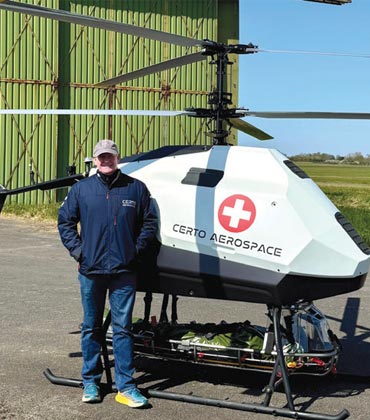
The fundamental aeromechanics for the majority of helicopters have remained unchanged since Igor Sikorsky’s VS300 first flew in 1939. The single main rotor provides lift and control, whilst the tail rotor counteracts torque, preventing the helicopter from spinning uncontrollably. Certo Aerospace has gone an alternative route, with two large, contrarotating rotors on the same axis (“coaxial”) dispensing with the tail rotor, thereby eliminating both 15 percent energy loss and the risk of serious failures in the tail rotor system. With a design ethos of simplicity and reliability, this coaxial approach avoids other inherent pitfalls of multi-rotor and tandem aircraft, such as rotor inefficiency, control complexity, and larger aircraft size. Certo’s CAPSTONE has a dry weight of 300kg but can lift another 300kg as fuel and payload, giving an impressive one-to-one ratio and a Maximum Take-Off Weight of 600kg. High-Flying Efficiency Meets Dynamic Payload Performance This exceptional performance results from the proprietary coaxial rotor head integrated with a high power-to-weight internal combustion engine using liquid fuels such as petrol and diesel. These standard fuels contain at least 20 times more energy per kilogram than the latest Lithium-Ion batteries, providing the payload, range, and endurance needed for realworld missions. “Uncrewed coaxial helicopter designs are a rarity, making our approach generally very distinctive.” says Justin Tooth, Managing Director. “However, we think coaxial is the logical choice, all things considered. And because we have cyclic and collective swashplates on both rotors, CAPSTONE has a uniquely powerful ability to generate lift with precise airflow vectoring for control in windy conditions or operating to the decks of naval ships.” With that working payload capacity of 300kg, CAPSTONE can transport a wide range of logistics payloads or mission packages driven by plentiful onboard electrical power. Trading payload for fuel enables lighter payloads to be carried further (up to 500km) or for longer (up to 8 hours), allowing operators to match CAPSTONE capabilities to specific mission objectives, including humanitarian assistance. Smart Design Delivers Mission Flexibility and Reliability The Modular Open Systems Approach (MOSA)—which encapsulates the use of modular design, modular interfaces, and conformance to open standards—underpins Certo’s scalable design. CAPSTONE can be easily reconfigured with alternative Command and Control systems (C2), BVLOS navigation, automatic take-off and landing systems, and mission equipment packages.
Design and Manufacturing Company

Angatec’s journey began in 2013 with a clear and deeply rooted mission. A group of engineers came together, driven by a shared purpose, to create something that was both innovative and essential. Their goal was to support those who run toward danger when everyone else retreats. The initial focus was on first responders and firefighters; professionals facing life-threatening risks every day. Recognizing their extraordinary commitment, Angatec set out to equip them with the advanced tools they deserved. The engineers also worked closely with the military, particularly the French ground forces, to better understand operational demands across different environments. Rather than develop separate solutions for civil and military use, the decision was made to combine all requirements into one integrated system. The result was a robust, modular and highly versatile robot that meets the needs of both sectors. It could fight fires, navigate debris, transport the wounded, carry equipment, perform surveillance, and maintain communication in disrupted environments. In essence, it was built to protect and save lives. Angatec’s early clarity on how the robot would be used was more important than the technology. The company drew a firm ethical line. The platform would not be weaponized. Its purpose would remain rooted in logistics, rescue, reconnaissance, transport and support. It would serve as a protector, not an aggressor, in war zones or disaster areas. “Our robots are built to handle the harshest conditions. They can carry out surveillance, assess the situation, and detect the presence of people. In the field, that level of situational awareness can be a game-changer,” says Adrian Diaconu, chairman. Centered Around The End User From the beginning, Angatec embedded itself with its users. Rooted in engineering, it did not rely on assumptions about what firefighters or military operators needed. It asked, observed, tested and refined. In France, it worked alongside firefighters in fire response training centers like Valabre, one of Europe’s most advanced facilities. The robots were pushed through live fire scenarios, dense smoke, water damage, and unpredictable terrain. Angatec collaborated with experienced firefighting professionals from Portugal, Germany, Spain and Greece. Their input proved invaluable. From fine-tuning the robot’s user interface to enhancing its ability to navigate rugged terrain and optimizing its camera systems for low-visibility conditions, every feature was shaped in close collaboration with those who would use it in the field.
CXO INSIGHTS

Recent Developments in Advanced 3D Sensing Applications
Ralph Gudde, Managing Director TRUMPF Photonic Components BV, TRUMPF

How Far has GIS Evolved?
Tiia Palvimo, Principal Global Product Owner, Ramboll

Smart maintenance with connected and innovative sensor technology
Emmy Pavlovic, Chief Product Officer, Bulten Group [STO: BULTEN]

Engineering a Sustainable Tomorrow
Jennifer Spence, HEAD OF SUSTAINABILITY STRATEGY, Essentra [LON: ESNT]

Predicting Wildfire Danger with Machine Learning and Remote Sensing
Beatriz Reis, Climate Data Scientist and Juhi Nagori, Climate Specialist, Haskoning

Digital Twins - The Context and Complexity
Anthony Tuffour, Director of Global Lead GIS and Digital Twins, Buro Happold

Shaping the Future of Traffic with Digital Innovation
Janne Lautanala, Chief Ecosystem and Technology Officer, Fintraffic


IN FOCUS

Driving Innovation: The Role of IO-Link Sensors in Europe's Industrial Automation
Europe’s measurement and digital IO-Link sensor solutions market grows with automation demand, smart manufacturing, and digital connectivity.

Advancing Smart Manufacturing Precision With Digital IO-Link Sensors In Europe
Digital IO-Link sensors enhance industry by enabling real-time data diagnostics, scalability and predictive maintenance across Europe.
EDITORIAL
Precision, Integration, and Control in European Industrial Automation
Industrial automation across Europe is entering a decisive phase, one where measurement integrity, system interoperability, and operational predictability define competitive advantage. This edition of Applied Technology Review Europe focuses on how digital sensing and connected architectures are addressing persistent challenges around signal integrity, calibration, and integration in increasingly complex production environments.
This issue’s cover story highlights Peter Hirt, recognized as the Top Measurement and Digital IO-Link Sensor Solution in Europe 2026. The company has redefined precision measurement by digitizing signals directly at the point of measurement. By integrating signal conditioning electronics into the probe itself, Peter Hirt reduces susceptibility to electrical noise while maintaining closed-loop calibration within the sensor. The use of IO-Link as an open interface enables straightforward integration into standard PLC environments, allowing measurement data to flow reliably through modern automation systems. Supported by a mechanically robust probe design and standardized digital outputs, this approach simplifies system modernization while preserving repeatability and long-term measurement stability.
The issue also examines applied innovation in connected sensor technology for maintenance intelligence. Emmy Pavlovic, Chief Product Officer at Bulten Group, outlines how connected clamp-load sensors provide continuous monitoring of critical fasteners. Cloud-based access to sensor data improves maintenance predictability, reduces downtime, and supports longer asset lifecycles across demanding industrial environments.
Leadership perspective further strengthens this edition. Jennifer Spence, ESG Director at Essentra, shares how structured ESG governance, lifecycle-focused material assessment, and value-chain collaboration translate sustainability objectives into measurable operational actions. Her insights emphasize the role of data, accountability, and engineering discipline in long-term industrial performance.
Together, the stories in this issue demonstrate how precision, connectivity, and execution-focused leadership are shaping the next phase of European industrial automation.

Top
