


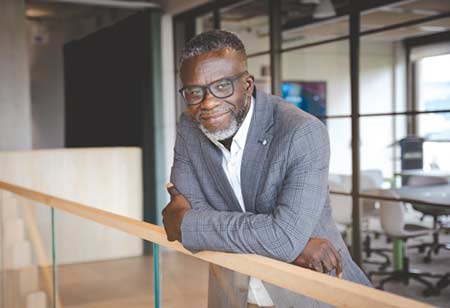
Anthony Tuffour is an accomplished Geospatial Data Science and Digital Twins professional with over 20 years of experience. He is skilled and has demonstrated expertise in GIS and Digital Twins applications in the architecture, engineering, and construction (AEC) sector, local governance, urban/spatial planning, physical asset management, railway engineering, and disaster risk reduction and management for city resilience.
Anthony is currently the Discipline Director at Buro Happold Ltd, leading its Global GIS and Digital Twins advisory, consulting and solutions delivery services and products to clients across the globe. His expertise translates to providing data-driven and technology services in areas such as digital Masterplanning, intelligent infrastructure design and construction, pathways to net zero and decarbonization with advanced analytics, automation, computation and intelligence. He also delivers an experiential and immersive visualization and real-time 3D to enable decision-making, data communication, and sharing at every level of the built environment, from rooms and buildings to campuses, cities, regions and countries.
Digital Twins - The Context and Complexity
Digital Twins has become a contemporary conversation as a unique technology revolution to tackle business challenges and tap into existing opportunities for deriving value and staying competitive. The concept is all about using data and digital technologies to develop an understanding of existing behaviors and cultures and the ability to simulate or model future outcomes for probable intervention to achieve resilience and minimize risks. In doing so, we need to understand the complexity and depth of what we are dealing with to achieve the desired outcomes. At the core, it has a comprehensive data management activity defined by the requirements of stakeholders and partnerships within the applicable context. It also includes data integration and interoperability.
Data governance and standards are necessary to ensure consistency and accuracy of different stakeholder groups with differing data systems and platforms based on each stakeholder’s behavioral activities and purposes. It is a move towards automation, reducing manual processes into a digital revolution to simplify tasks and execute them quickly while providing assurance and certainty of outcomes. Digital Twins integrates advanced data analytics and intelligence to make sense of vast amounts of data and can undertake simulation and predictive modeling to answer what-if questions. This is realized through interfaces with AI and ML techniques.
“Digital Twins has become a contemporary conversation as a unique technology revolution to tackle business challenges and tap into existing opportunities for deriving value and staying competitive.”
The narrative or applicability of Digital Twins can sometimes take time to comprehend. It is, therefore, necessary to provide an interface and immersive platform to enable interactions between stakeholders, clients, and customers. It offers the ability to touch and feel one’s environment and interact to understand how problems are solved or envision a future without being aware of the complexities behind what the twin is enabling. It is also about bringing different systems and platforms together to achieve a common goal in a technology-driven environment that can either be on-prem, cloud or a hybrid ecosystem.
One critical piece that needs to be understood is contracts and the legal framework in which the twins exist and operate. IPs, data ownership and protection, service provision, access rights and permission must be understood and framed within the Digital Twin ecosystem to resolve conflicts and achieve speedier implementations.
Digital Twins - Use Cases and Application Areas
During my career, I have architected the development of varying applications of Digital Twins to different use cases. These use cases were designed to resolve critical and complex issues, including requirements for sustainable living, demands for enhanced user experience and quality of life, infrastructure delivery, local conflicts and dissatisfaction with service provision, unreliable travel and mobility systems, and dealing with vulnerabilities and resilience measures of countries affected by disasters.
One typical project was responding to a client who wanted to use a Digital Twin to create exciting Urban Environments and Lifestyle Communities. The task was to make it immersive and provide real-time data streaming to a gaming engine for an immersive experience, stakeholder engagement, and collaboration. The key motivation was that the Digital Twin be used to regenerate an existing city to exploit its tourism potential and deliver the specific integrated use cases: use of advanced analytics function for road closure simulation and logistics planning, infrastructure delivery program scheduling simulation, escarpment and constraints analysis, and clash detection between old and new developments. It also allowed in-session design development considerations from stakeholders’ perspectives, solar analysis, and energy demands dependent on infrastructure supply requirements.
Environmental protection and sustainability are critical organizational goals that attract increasing investments. Another Digital Twin use case implemented was Smart Energy Digital Twin: Pathways to Net Zero. It was about developing an analytical tool to decarbonize off-gas grid communities. The DT modeled variables such as energy demands, building stock and archetypes and retrofitting summaries, technoeconomics, carbon emissions and cost, district heat network appraisals, renewable energy schemes, rooftop PV potential assessment, carbon tax and fuel poverty insights. The influence of data changes was factored into the analysis to provide real-time, accurate outputs. Based on this work, Buro Happold can create a replicable model that may be applied to other UK regions. Digital Twin applications provide a tool for clear communication and visualization of energy data—with real-time representation and custom data models.
In transport and mobility use case application, I led the development of a Railway Track Decision Support solution to optimize track upgrades and renewal works that improve track speeds and meet revised timetables. The solution used Geospatial Science and Digital Twin to automate the processing and integration of multiple datasets to gain insights and intelligence of the track network, facilitate renewal works, save on costs, and achieve tight delivery timelines.Optimizing the reliability and safety of transport infrastructure requires ready access to data, information, and insights from multiple sources. Modeling railway stations across a transport network and integrating them into other systems afforded engineering workers an understanding of the availability of the network against competing demands to carry out their work.
Challenges to Navigate and Achieve Successful Delivery
Delivery of data and technology solutions can sometimes be straightforward because we always know what to do. However, difficulties surface when navigating the people involved against competing demands, organizational culture, power, and political dynamics. Any digital twin solution must fit, should solve a local problem and be relatable.
There is increasing excitement and buzz around Digital Twins, especially the potential integration of AI and ML techniques, which has energized organizations to adopt it. However, there needs to be more consideration of the purpose to which they must be applied. Understanding the intended need and complexity of what one is embarking upon is paramount.One of the critical outcomes of Digital Twins is the ability to model and predict future states for intervention; data quality is crucial to realizing certainty of the outcomes intended. Profit maximization and value realization should only be expected with the proper quality input datasets.

